
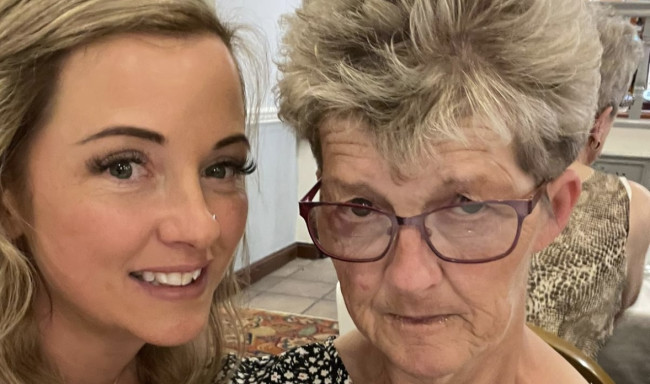
Sharon shares what changes in behavior and communication her daughter has experienced and how she manages these.
Even if someone can't communicate very much, sitting and talking with them shows that you care. They're still in there. Your person is still there.
Sharon, from London has been impacted by Huntington’s disease for 50 years. She lost her husband, Ray in 2005, her son, Robin in 2020 and is now a part-time carer for her daughter, Kerrie-Ann who is in the later stages of the disease. Over the years Sharon has watched her loved one’s personality and behaviour change as well as communication with them becoming increasingly difficult.
My daughter was a very chilled, quiet and unassuming woman. She has now become more assertive and can sometimes be aggressive. She wants more food, more attention and things done immediately. That's not how she used to be. When she feels misunderstood, she shouts. I know it's because she's trying to get the words out, but it was a shock because she wasn't like that before.
Symptoms present differently person to person and that includes in families and siblings. For Sharon’s son, Robin, he became monosyllabic quite early on. Sharon had a background in speech and language therapy so knew that communication boards would be beneficial for him. She used boards with pictures of food, clothes and other items so that he could point to what he wanted.
With her daughter Kerrie-Ann, communication is still possible although she is at a stage where the frustration of being unable to be understood or say what she means, is causing her to get angry. Sharon says that when they are at home, her technique is to listen for a keyword and try to understand what her daughter means from that one word.
Once, I misunderstood her so completely that she burst out laughing. We laughed together and it calmed the situation, although that doesn't always work. Usually, we can work through it until we're laughing, or I give her a hug. She has become very affectionate and likes to be hugged. If that makes a difference, I'm all for it.
Unfortunately, this isn’t so easy when they are out and about and there are more people around. Sharon finds it difficult to hear her which means Kerrie-Ann must try harder to explain, and ends up exhausted. This then causes frustration and leads to Kerrie-Ann interrupting because she simply just wants to be heard. These sorts of situations become really overwhelming for her.
If she wants something, such as medication, a drink or to go to the toilet, she can become quite angry when I don't understand her. If I can't pick out that one word that gives me the meaning, it becomes difficult. She may get up because she's cross, and then she might fall.
What has helped your communication?
"I make sure she's looking at me and try to cut out background noise. That helps both of us because her speech isn't as clear now. If I don't understand her, I try to pick out a word, so I have some context.
Sometimes I hold up objects if I think one of them might be what she wants. Communication boards can also be used for food, snacks and activities.
I make sure I'm close and sometimes hold her hand. Touch seems to have a soothing effect on her, although that didn't work for my son. This is my third experience of Huntington's disease in the family, and it is still different each time."
What support and information have helped you?
"Our Huntington's Disease Association adviser, Anna Holmes, is the most supportive person in my life. I'm also the treasurer of the London branch, and supporting other people helps me too. Sometimes people simply want reassurance, someone to listen or practical advice from someone who has experienced a similar situation.
The Huntington's Disease Association website has excellent information. I particularly like the top ten tips because they're concise, easy to read and not overwhelming. If you have Huntington's disease or you're exhausted from caring, you may not have time to read pages and pages of information. We hand the tips out at our meetings.
I also like HD Buzz because it shares positive news about research and trials. It may not help my daughter, but it will help somebody.
Social media groups can be very supportive too. Sometimes it doesn't matter exactly what someone says. Simply acknowledging a person and telling them they're doing a good job, or suggesting something they could try, can make a difference."
Managing behaviour and communication changes
You can find out more about how a person's behaviour and communication are impacted by Huntington's disease. On the page below we share management tips for each stage of the disease, personal stories and frequently asked questions on this topic.