How Huntington’s disease affects behaviour and communication
This information explains how a person's behaviour and communication are impacted by Huntington's disease.
It will cover:
- Communication and behaviour symptoms
- Communication management at different stages of the disease
- Frequently asked questions
- Communication tips
- Lived experience stories
- Advice blogs from Speech and Language Therapists
- Videos and webinars
- Where to go for support
The effect of Huntington’s on communication can be divided into three areas
Difficulty speaking clearly
This is called dysarthria. People with Huntington’s disease will usually experience the hyperkinetic (excessive movement) form of dysarthria. The excess movement fits with the choreic movements associated with Huntington’s. It can present as irregular or erratic articulation and a lack of rhythm in speech.
People may also experience irregular breathing patterns, including sudden inhalation and exhalation. This can affect the volume of their voice. Someone may speak very quietly at some points and very loudly at others.
Speech rate can also change. Some people may speak very quickly, while others may speak very slowly.
The exact presentation will vary from one person to another.
Problems processing information and communicating
This is called cognitive-linguistic impairment. As a person’s cognitive functioning changes, this can affect their language and wider communication skills. People may have difficulty understanding what others are saying. They may find it harder to process information and make sense of what they hear. A person may need longer to process what they hear, understand what is being asked and formulate their response.
People may find it difficult to generate ideas. When they have an idea, they may find it difficult to express it coherently. Someone may become stuck on particular words, phrases, topics or thoughts and return to them repeatedly as well as experiencing word-finding difficulties.
Over time, their vocabulary may diminish. They may use fewer words, shorter phrases, shorter sentences and simpler sentence structures.
Changes in social interaction
The cognitive effects of Huntington’s disease can interact with neuropsychiatric symptoms such as depression and anxiety. Together, these can cause significant changes in social interaction. People may find it difficult to maintain their attention. As the disease progresses, it can become increasingly difficult to focus, particularly when there are distractions in the environment.
Some people may experience apathy, reduced emotional responsiveness, lower levels of motivation or withdraw from interaction.
Others may display behaviour that others find challenging. A person may become frustrated when they are not understood or when their communication partner does not give them enough time to formulate a response. This might result in verbal aggression or changes in body language, which can make other people feel less comfortable communicating with them.
Managing communication changes
The support someone needs will change throughout the progression of Huntington’s disease. What is helpful at one stage may no longer be appropriate at a later stage. Support should be guided by what the person wants and what is important to them.
Where appropriate, professionals should also work closely with the person’s family, friends and other people supporting them. Multidisciplinary working is particularly important. The complex interaction between the physical, cognitive and neuropsychiatric effects of Huntington’s disease means that interventions are more likely to succeed when professionals work together.
Total communication
A total communication approach can be very helpful for someone with Huntington’s disease. This involves using all available methods of communication and building on the person’s strengths. This can be unaided communication such as body language, pointing or vocalisations or low-tech and high-tech communication aids such as pen and paper, keyboards or voice aids.
Whether an aid is suitable will depend on the person’s physical abilities and cognitive functioning. An aid someone can use at one stage of Huntington’s disease may become difficult or impossible to use later. Professionals should consider how the aid may need to be adapted as the person’s needs change.
Maintaining social interaction
Supporting continued social engagement is important. A person’s social participation may naturally reduce for many reasons as Huntington’s disease progresses. It may be possible to adapt how and where the person socialises. They may find it easier to meet in smaller groups or invite people to their home rather than going to a busy venue with background noise and distractions.
Mental capacity assessments
Speech and language therapists may have an important role in mental capacity assessments. The Mental Capacity Act states that all practicable steps must be taken to support someone to make their own decision before they can be assessed as lacking capacity. Speech and language therapy support may help someone demonstrate that they remain able to make a decision when, on the surface, this may not appear to be the case. Even when someone lacks capacity, the assessment process may identify their preferences and wishes. These can then inform best-interest decision-making.
Managing communication in early-stage Huntington's disease
In the early stages, a person may have:
- Mild dysarthria
- Mild cognitive communication difficulties
- Changes in their usual interaction style
- Subtle behavioural changes affecting relationships
Support from a speech and language therapist
An early referral to speech and language therapy is recommended. This allows the therapist to begin building a relationship with the person, provide information and advice and complete assessments where appropriate. Formal and informal assessments can provide information that guides support. They can help identify the person’s strengths and areas of difficulty. An early assessment may also establish a baseline against which future changes can be measured.
For some people in the early stages, there may be an opportunity to use rehabilitative approaches that focus directly on the impairment. For example, depending on the presentation of the person’s dysarthria, they may benefit from laryngeal relaxation techniques or voice exercises that improve the coordination of breathing and voicing. For other people, compensation and changes to their environment may already be more appropriate. This could include identifying conversational repair strategies that work for the person and their communication partners. Information and advice should be provided to both the person with Huntington’s disease and the people around them.
Communication in relationships
It is important to understand how communication changes are affecting the person and their relationships. Research shows that what the person with Huntington’s disease identifies as their main communication difficulty may be different from what their family members or caregivers consider to be the main difficulty. Professionals should explore the experiences of everyone involved.
Managing communication in middle-stage Huntington's disease
During the middle stages, the person is likely to have increasing difficulty communicating effectively and listening actively to other people. Their speech may become increasingly difficult to understand, and their dysarthria may be more pronounced.
Because of cognitive changes, they may find it harder to learn, remember and initiate communication strategies. They will become increasingly dependent on communication partners to use strategies, provide support and scaffold interactions. A person’s insight may also change. They may be less aware of the difficulties they are experiencing or how difficult their speech has become for other people to understand.
Communication strategies
Conversation partner training can be very helpful. The training should be tailored to the individual’s needs, preferences and priorities. Family members and other communication partners can either create barriers or provide valuable support during interactions. Helping them understand and use appropriate strategies can make communication more successful.
Talking Mats can be particularly helpful for people with Huntington’s disease. Talking Mats is a structured communication tool that can support understanding, reduce cognitive demands and help someone express their ideas, thoughts and preferences. It can also support mental capacity assessments.
Managing communication in later-stage Huntington's disease
In the later stages, the person may no longer be able to communicate intelligibly through speech. Their cognitive functioning is also likely to be severely affected. They may retain some understanding of very simple information, particularly when supported with visual cues and context. Their ability to use augmented alternative communication (AAC), writing, gestures or other compensatory strategies is likely to be greatly reduced. They may no longer be able to access these methods.
Communication strategies
Professionals should look for any residual communication skills that remain. This may involve a very simple system, such as:
- Thumbs up or thumbs down
- Nodding or shaking the head
- Choosing between two objects
Even if a yes or no response is not completely reliable, people supporting the individual should be made aware of it and continue encouraging participation. The person should continue to have opportunities to communicate and make simple choices. Positive interactions and experiences should also continue.
The person may no longer be able to participate in a conversation, but they may still enjoy sitting with someone they love, having their nails done, receiving a hand massage or sharing another enjoyable experience.
Guidance should continue to document and communicate the support the person needs so that they can participate for as long as possible.
Managing non-verbal communication
Choreic movements can affect body language, facial expressions and the ability to maintain eye contact. These changes may affect how other people perceive someone with Huntington’s disease. They can lead to misunderstandings about the person’s mood or intentions.
Physical changes may also make it difficult to use gestures, writing or other ways of supporting communication. A person may have difficulty accessing augmentative and alternative communication, or AAC, including communication aids they previously used.
In the early stages of Huntington’s disease, these changes may be subtle. They will usually become more noticeable as the disease progresses, increasingly affecting the person’s ability to express themselves and understand others.
Behaviour and communication blogs and stories
Lived experiences
Communicating in a different way - Lauren's story
Carers, Community stories
Read more
Your person is still there - Sharon's story
Community stories, Carers
Read more
Dignity must remain central to their care - Susan's story
Carers, Community stories
Read more
Communication didn't stop just because her speech did - Nikita's story
Carers, Community stories
Read more
Useful information about communication
What is a Speech and Language Therapist
Carers, Professionals, Advice
Read more
Speech and Language Therapist - Professional perspective
Professionals, Advice
Read more
Voice banking
Support, Young adults
Read more
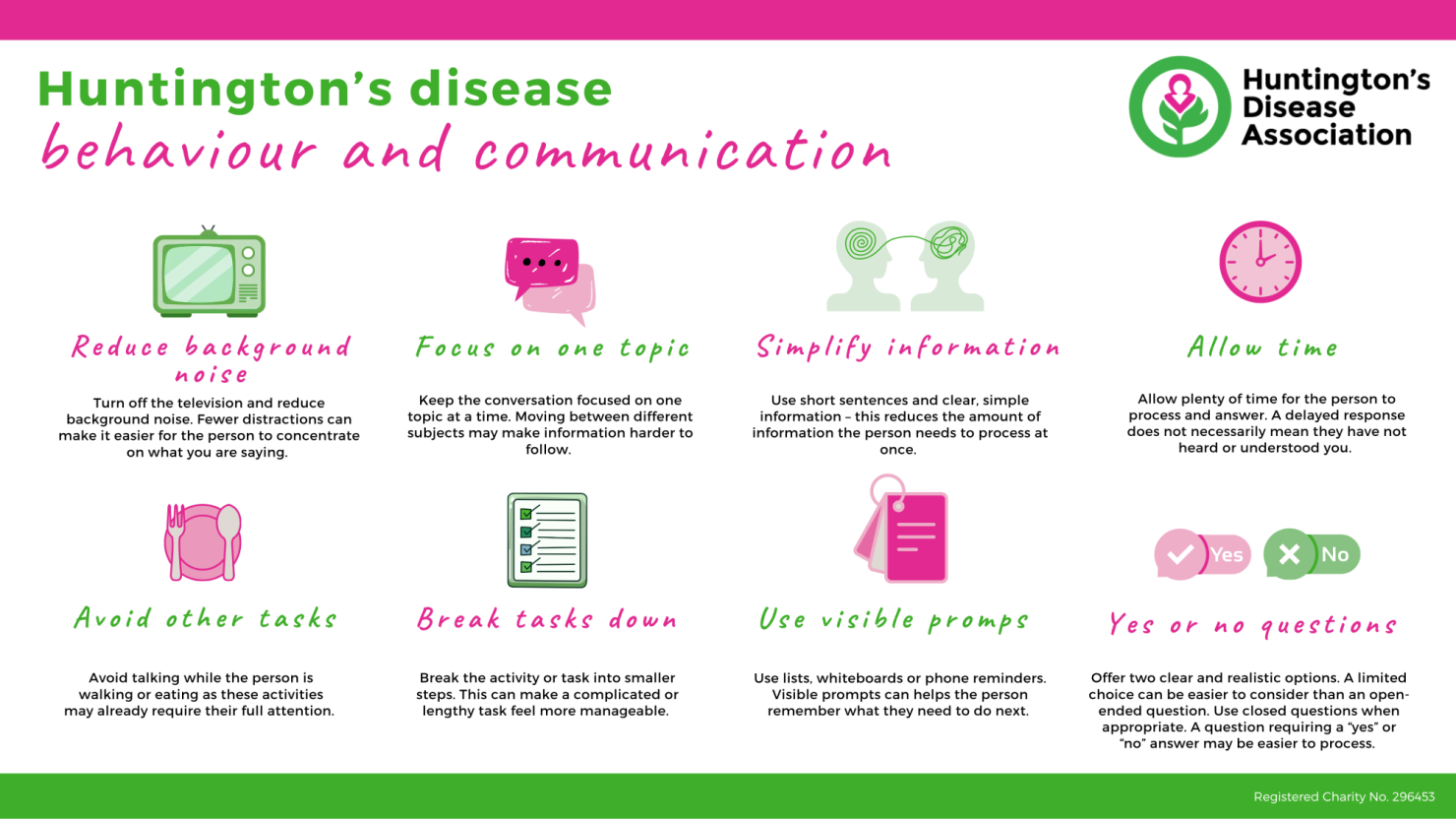
Communication and behaviour top tips
We have compiled a list of top tips when it comes to managing communication and behavioural changes in your loved one. This handy guide can be downloaded for you or to share with someone who may find it useful.
Download the guide
Professional guidelines around speech and language therapy
These guidelines have been written by healthcare professionals.
Erin Probert is a Clinical Lead Speech and Language Therapist at the Royal Hospital for Neuro-disability, London. She has extensive experience working with people with Huntington’s disease in a specialist inpatient setting, supporting them with communication, swallowing and decision making. Sarah Roberts is a Highly Specialist Speech and Language Therapist working in the NHS, with a special interest in progressive neurological conditions. Sarah has been working with adults with neurological conditions for the past 10 years and has worked across both inpatient and community settings.
These guidelines are for healthcare professionals. You can download them and share them with relevant professionals to help them to better support you or your loved one.
Download the guidelines