

On 19 May, we will be in Parliament to launch our report, called ‘Support at every step: Improving care coordination for people living with Huntington’s disease’.
The report calls for all people living with the condition to have a named professional, such as a nurse, acting as a single point of contact to coordinate their care.
Care coordinators can liaise with the range of providers a person may need support from, in areas including mental health, occupational therapy and social care. Crucially, they act as a bridge between a person’s Huntington’s disease clinic and community services. Their role involves educating health and social care professionals to ensure they have the knowledge to provide high-quality and joined-up care to people living with Huntington’s disease.
We would like to thank Helen Grant OBE MP for sponsoring the event and enabling it to take place.
The report will be launched during this year’s Huntington’s Disease Awareness Month, with the theme of Behind the Gene highlighting the invisible challenges and untold stories of Huntington’s disease. The report highlights good practice with an example of a Neuro Navigator whose role includes coordinating complex medical care, delivering well-organised logistical support, acting as a bridge between healthcare and other services, such as benefits.
For the report, we surveyed over 250 people affected by Huntington’s disease. Over three quarters (76%) reported difficulties with washing and dressing, and more than one in five (21%) said they used a wheelchair. Despite living with these complex health and social care needs, almost two in three people (65%) said they did not have a named professional to coordinate care across different health and social care services.
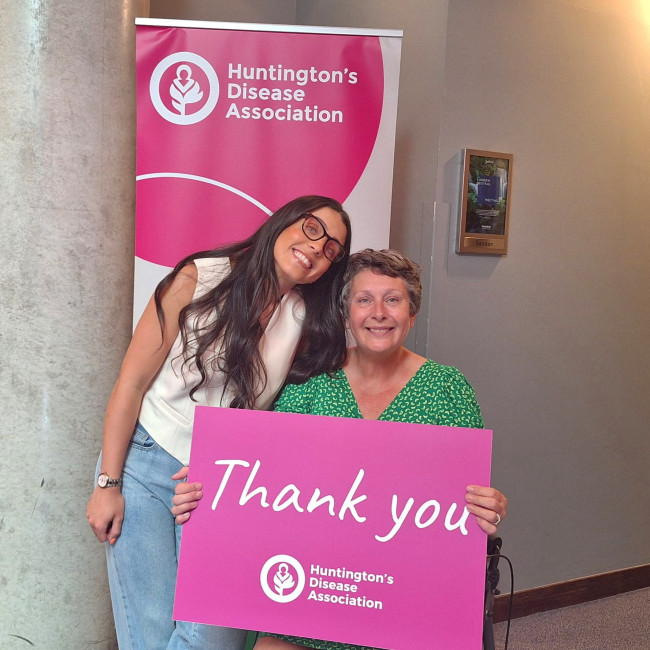
We spoke to Charlotte, who looks after her mum, Elaine, who has Huntington's disease.
“I coordinate everything. My dad looks after mum when the carers are not there, but I liaise with all of the medical professionals involved in her care. I counted the other day how many there were, and over the past 18 months, she has seen 25 different teams, each with multiple appointments and clinicians to engage with.”
Over six in 10 people (62%) said they needed to explain Huntington’s disease to a healthcare professional in the past 12 months. Charlotte explained the difficulties of dealing with health and social care professionals who do not understand the disease
“Once we went to an appointment, where a specialist didn’t know we’d seen another professional and completely contradicted the advice given. My mum was really confused and then became agitated because of this. She struggles to engage with professionals but really switches off when she knows people lack knowledge or when things haven’t been coordinated.”
When asked about the difference, a care coordinator would make Charlotte said,
“A dedicated Huntington’s disease care coordinator - one person who knows the disease, who joins up the services, who picks up the phone - would change everything. It would give me back the hours I lose to admin. It would mean my mum’s care doesn’t depend on whether I’m well enough that week to fight for it. It would mean I get to be her daughter again, and I really miss being her daughter.“