
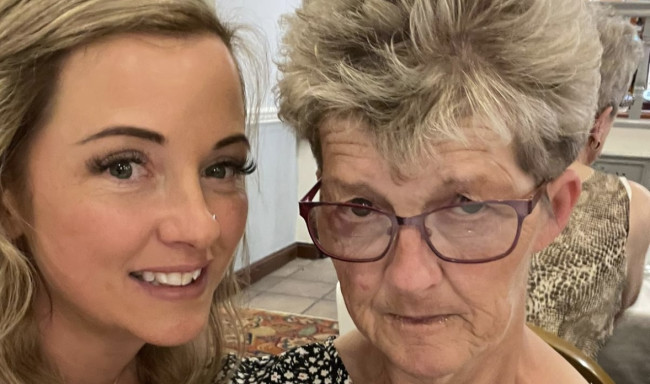
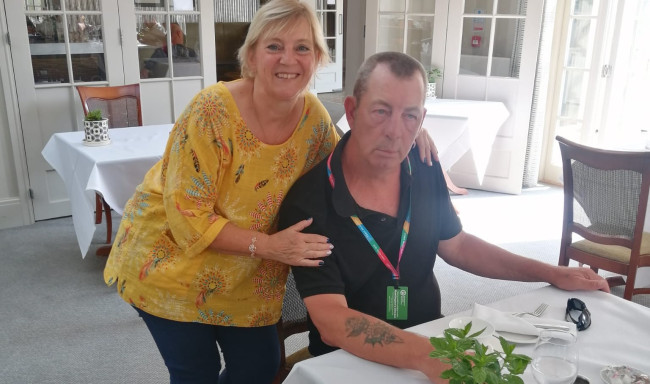
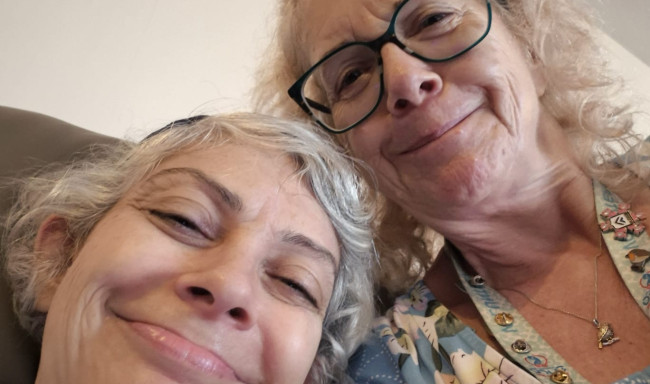
Susan shares her story of the day Huntington's rippled through her family and how she vowed to get her husband the best possible care.
I was the one who had to bear the bad news which was so horrific. Three generations in a flash, literally within that day.
The ripple effect through families
Susan, a carer and ex-teacher from Norfolk, saw the ripple effect of Huntington’s disease sweep through three generations of her family as she sat in the doctor's office as her mother-in-law received her Huntington’s diagnosis.
The doctor asked if she had Huntington’s in her family to which her mother-in-law replied “oh no, not that”. Susan had never heard of Huntington’s and asked the doctor to explain. She found out her mother-in-law's mother had it but never told anyone.
My heart stopped beating. I realised at that point that I had to tell not only her husband, but also my husband and we had a two year old child. Three generations in a flash. It was a massive shock. But I thought, right, I've got to be practical. I need to tell them and I need to think what's the best support I can give and where can I get the best support.
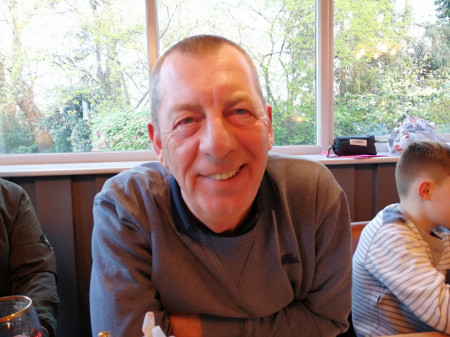
Talking about Huntington’s with their daughter
I had a terrible fear for my youngest daughter when I realised her chance of inheriting it was 50:50. This could be something I've got to face in the future as well.
Susan decided from the beginning that she would not hide Huntington’s from her daughter. Over the years, she would explain to her why her granny was wobbly and had different movements. She explained that is might happen to her dad and her uncle and also maybe to her, but assured her that if it did, she would take care of her.
Susan describes her daughter as a bright child, who, at eight, had now realised that it was Huntington’s disease that had killed her granny. She started to ask more questions and Susan would dip in and out of the subject whenever she needed to. Her daughter started to make symptom comparisons between her granny and her dad but they would very openly talk about it and she' say, "I've told somebody at school and they don't know what it is.” Susan would respond with, "That's okay. Can you, can you let them know what it is? I'll give you some information.”
Getting Tracy’s diagnosis
Susan vowed that they would live their lives to the full. They lived near the sea, and they had the grandchildren over every school holiday and made special memories with their family.
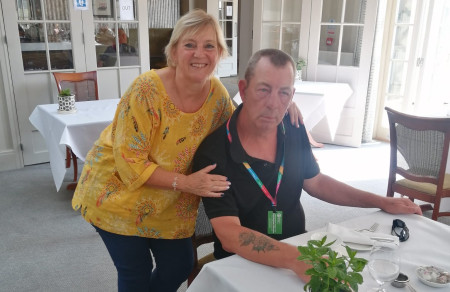
Susan began to notice symptoms in Tracy in his early 50s. Flicking his arm, flinching his face, but also changes in his behaviour and developing paranoia. He was in denial but Susan knew. She said to Tracy:
I've a feeling you might have it, and I'm sorry, but I need to know. I need to know because I will get you the best care at every stage of Huntington's. I will fight for you beyond belief to get everything that you need and the very best care.
As Tracy’s symptoms developed, he stopped going out and became quite reclusive. One morning, Susan left him sitting on the bench in front of their house and when she returned from work he was still there. “Have you been in love? You’ve had a drink haven't you? And he said,” I think so”. But I went in the kitchen and realised he hadn't eaten or drunk all day. He’d just sat on the bench staring out outside. I thought, Oh, heck, I think we know where we're heading now.”
Without the help of Susan, Tracy could no longer eat or look after himself so she give up her job to care for him full-time. Although unable to fend for himself, Tracy never stopped being able to look after their dog.
Everything that the dog, Daisy needed, he knew what to do. He would feed her every day, water her and he would take her for walks. Daisy the dog was paramount.
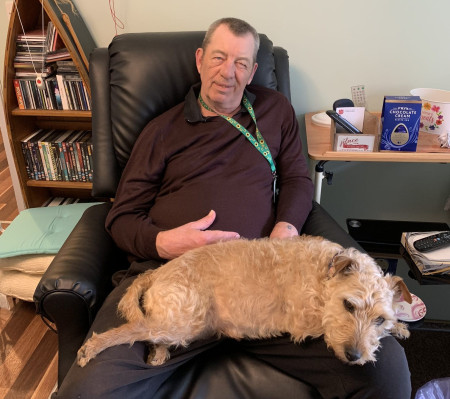
As symptoms progressed, Susan became exhausted. She’d dealt with an illness herself and had been going through the motions of being a carer for over 10 years. It had taken its toll.
Respite after burnout
My daughter actually phoned an ambulance because I'd been in bed for about three days. I was ill, utterly exhausted because Tracy was always getting me up in the middle of the night.
That’s when Susan was given some respite. The ambulance called Social Services and organised for Tracy to stay in a home for five days. During his stay they called and extended his stay before reassessing him. “It might be time for you to to let him go and to let him go into care because his needs are too big for you now. He needs 24/7 care,” they said to Susan.
Their social worker found a home nearby although they were unable to find one that specialised in Huntington’s. Tracy moved in and stayed with them for around 18 months. They didn’t understand how to look after him properly, and he was becoming aggressive toward other residents because he was frustrated. He had patio doors and during the night he would want Susan and he would escape. The last time this happened a lady found him on her drive; his legs had given way from walking so far. It was time for him to find a more suitable home.
Tracy was admitted to hospital while waiting to find another home. This is when the wrong care really started to impact his condition.
He truly nearly starved to death. He wouldn't wear clothes, and his bedding was filthy. I thought I was going to have to start sorting a coffin. It was just awful.
The staff at the hospital told Susan that he wouldn’t eat and that he kept throwing the plate. She looked at cling-filmed covered plates and told the staff that he cannot get it off so that is why he will be getting frustrated. But they didn’t listen.
There's a little booklet for professionals how to approach them in the hospital and another about what is Huntington's is. I gave them both and they were put in his record. Not one person in the hospital read them.
Wrong place but right care
Social Services finally managed to secure a spot in a specialist Huntington’s disease care home run by Elysium, a Huntington’s Disease Association-accredited home. The only problem was that it was in Hereford and four hours from Susan. She was assured by the home, her Specialist Adviser, Dawn and by Social Services, that this home would be the best place for him.
The first time I visited, he was still in the pyjamas from the hospital. He was just lying there. He's just literally lying there. And I said to the manager, Is he okay? And he went, “He's going to be like this for quite a while, and we're going to leave him alone because he just needs time. There’s a guy at the door 24 hours a day and they take notes all the time. They said if he asks for a drink, he will get it. If he asks for food, he will get it. If he needs the toilet, they will watch him to see if he can go. We literally leave them alone until he comes round and he realises that he's in a strange place. And then we slowly, slowly introduce staff.
Then, something strange happened. A lady walked in with her dog. She asked Susan if it was ok to bring her dog into their room. “His eyes lit for the first time in days and this big smile came on his face.” Susan said. The lady started to pass treats to Tracy to give to her dog, Monty. This was a turning point for him and Susan knew in that moment that he was going to be ok.
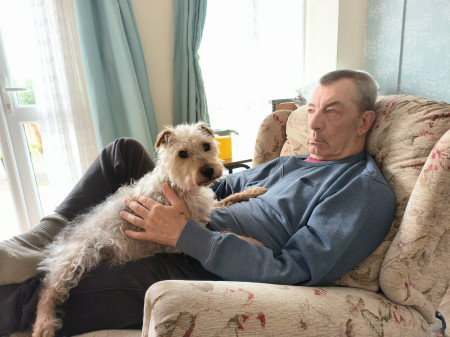
Tracy is now fully settled in Stanley House care home and Susan travels up every other week to see him. She describes the care for him there as amazing.
Sometimes I call the charity and say I just really miss him , I can't go on, I'm having a terrible week,. And she'll [Dawn] just talk me around. So I'll have a good cry with her and it really helps. They're just there when I need them. It's as simple as that.
Susan has been able to dip in and out of the Huntington’s Disease Association services when she has needed. She utilised her Specialist Adviser to help with advice, signposting to additional support and most of all, being that listening ear when she has needed it.
What do you wish people knew about Huntington’s
I wish that especially the medical profession understood the symptoms, realised that it's there's the neurodegenerative side and there's a physical side, but there is a person in there who understands everything they're saying. At the end of the day, that's a human man. You’ve got to keep that. It's why when he went to hospital, he was just angry because they did not treat him like a man.If there's nothing else, it's that knowing how to approach that person that first day, that first moment, looking at them and knowing that they understand what they're about to say.
Huntington's Disease Awareness Month 2026
This year's theme is Behind the Gene - The invisible challenges and untold stories of Huntington’s disease.
This May, we are showing the many faces and many lives behind Huntington's disease and what they wish people knew. Too often, people affected by Huntington's disease find themselves educating the public and healthcare professionals about their condition.
As part of this campaign, our aim is to educate more professionals about Huntington's disease. To do this we have created a new factsheet that is being distributed to GPs and health care settings across England and Wales.